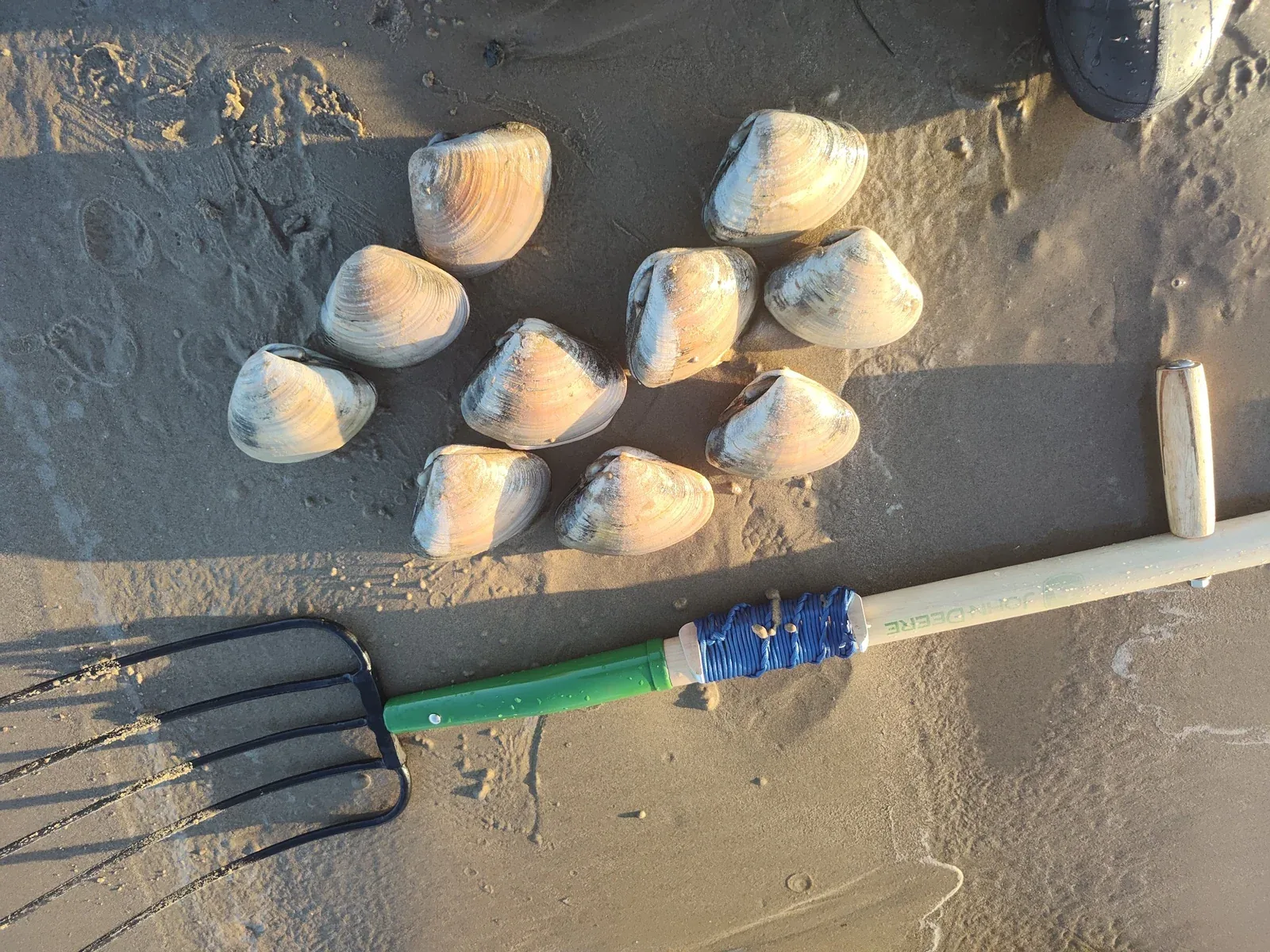
Pismo clamming is the most accessible recreational clam fishery on the planet. The technique is straightforward: walk into the surf zone at low tide (check the Pismo tide chart to pick one, and see where to clam at Pismo Beach), probe the sand with a tined fork, lever clams out where the tines strike, measure each one against a gauge, keep the legals, and rebury the rest. A first-timer following the procedure on this page will typically find their first clam within a minute or two of starting to probe. The work has a real rhythm to it — and a real safety dimension — but the difficulty curve is forgiving in a way that makes Pismo distinct.
This page describes the field procedure used by working Pismo clammers. Read the Regulations page first; the legal requirements (4.5-inch minimum, accurate rigid measuring device, immediate rebury of undersized clams, separate container per harvester) are not optional and not separable from the technique itself. Read the Safety page too; the surf at Pismo is forgiving most days and unforgiving on the days it is not, and the technique below is designed to keep eyes on the ocean throughout.
Watch It Done
The procedure described below is more readable in motion than on the page. The video below shows a working Pismo clamming session — the walk-in, the probe, the lever-and-lift, the measure-and-rebury sequence — in real time and conditions. Recommended viewing before reading the rest of this page.

Before You Start
Working in the surf zone with multiple loose objects in hand is harder than it sounds. The single most useful preparation is to consolidate gear before walking into the water — above all the right clam fork and measuring gauge:
- Clam fork — a four-tined potato fork is the standard. A measuring gauge mounted to the handle keeps the gauge on you wherever the fork goes.
- Catch bag at the waist — a mesh bag tied or clipped to a belt keeps both hands free for the fork. Diver-style mesh catch bags work well; purpose-built clamming bags (mesh, drawstring, designed to hang from a hip belt) are increasingly available and are coming soon from CXB-Designs.
- Bucket — if you bring one for transferring clams off the beach at the end of the session, leave it high on the dry sand, well above the wet line. A bucket left near the water will be in the surf within minutes; the next sleeper wave will take it.
- Waders or wetsuit — chest waders are standard for the shallow surf work this page describes. Clammers targeting the largest "king" clams in deeper water generally wear wetsuits. See the Equipment page for specifics.
- Fishing license — in your immediate possession, not in the car.
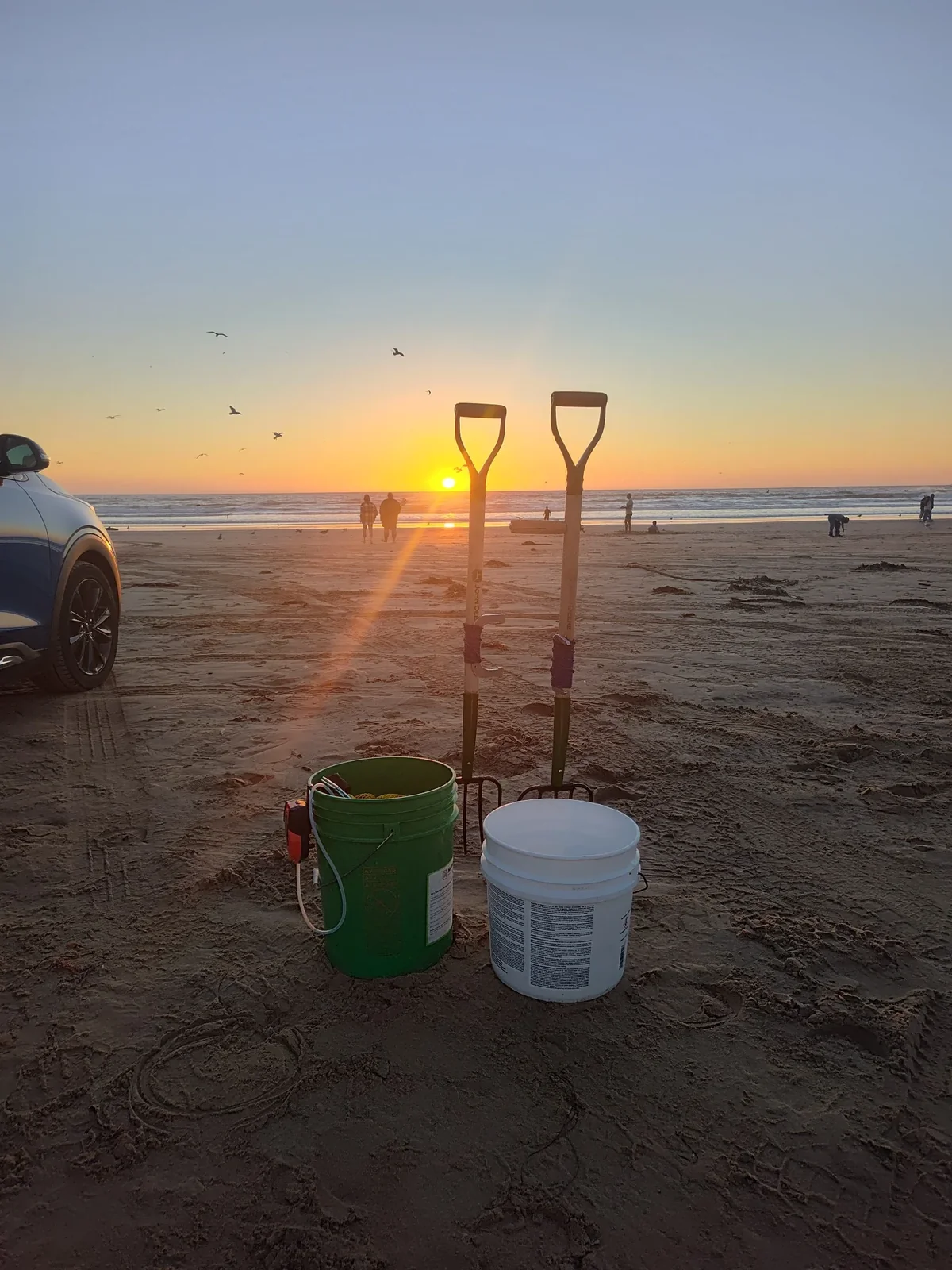
Walking down the beach with the fork in one hand, the gauge already on the fork, and the catch bag already at your waist means you walk in carrying one object and come out with hands free to manage clams. This matters in surf.
Finding the Strike Zone
Pismo clams sit in a band along the lower beach. The band starts somewhere below the high tide mark and extends seaward to roughly thirty meters of water depth — well past the surf line, into territory that only divers in wetsuits can reach. The shallow, accessible portion of that band is what most surf clammers work, and where exactly within it the productive zone falls on any given day cannot be predicted from a chart; it has to be found by probing.
The procedure is iterative and fast:
- Walk down the beach toward the ocean from where you set down your bucket. Keep your eyes on the surf as you go.
- When you reach a point that feels like it might be far enough — a guess on your first session, an instinct after a few sessions — stop and probe straight down with the fork.
- If the fork sinks easily through several inches of sand without striking anything solid, you are above the productive band. Move about 10 feet closer to the ocean and probe again.
- Repeat until the fork strikes something solid.
The strike feel is unmistakable once experienced. The fork tine simply stops, and the contact sounds and feels like a crunch against a rock. There are essentially no rocks on Pismo Beach — what you have struck is a clam shell.
The right zone is something experience teaches quickly. New clammers should not over-think it; the iterative probe-and-step procedure surfaces the band reliably within a few attempts regardless of where they start. The productive band is closer to the surf at minus tides and farther up at modest low tides; both come with practice.
The Working Stance
Once you have located the productive band, change orientation. Instead of facing the ocean (as you did to walk in), turn sideways. Stand with one shoulder pointed at the ocean and the other pointed up the beach. You will work along the beach by stepping backward in this sideways orientation, not toward or away from the water.
Most clammers settle on a preferred side. Some prefer the left shoulder to the ocean; some prefer the right. The choice usually maps to handedness and to which eye is dominant for peripheral vision. Try both and pick what feels natural.
The key advantage of the sideways stance: the ocean is always in your peripheral vision. You can probe and lift without ever turning your back on the water, and a glance over your shoulder takes a fraction of a second. This is the practical reconciliation of the technique with the safety rules — and it is also genuinely how productive Pismo clammers work, not a compromise invented for safety reasons.
The Two Rules, applied
From the Safety page: don’t turn your back to the ocean; don’t take your eye off the ocean. The sideways stance satisfies both. The work is engaging and sometimes exciting — especially when clams are striking the fork — and that is precisely the moment when the rule matters most. Stay in the stance. Glance to the surf every few seconds, every probe. Even on calm days. Especially on calm days.
Probing and Locating
Pismo clams sit with the top of the shell roughly two inches below the sand surface. The fork does not need to go in deep to find them — quick, shallow probes are more productive than deep digs. The technique is rhythmic and fast.
- Drive the fork tines straight down into the sand. Two to three inches is enough.
- If you feel nothing, lift the fork out and move it back about two inches — a small step in the sideways direction you are working.
- Probe again.
- Repeat. Move quickly. Productive clammers cover ground at roughly the pace of a slow walk while probing every step.
In a productive band, strikes come every few inches. You will hit a clam, then probe again two inches over and hit another. The density varies with sand movement and recruitment, but in a strong year a single working line can produce a daily limit of ten clams within tens of feet of beach.
If you are probing in a band and getting nothing, the band may be a few feet farther in or out from where you are working. Step toward or away from the ocean by a few feet and try again. Do not give up on the beach; on a productive day the clams are always somewhere, and the iterative procedure finds them.
The Extraction
This is the part of the technique most people get wrong on their first session, and it is also the moment when ocean awareness matters most. Read it carefully.
Once a probe strikes a clam:
- Lift the fork out of the sand, then reposition the tines about two inches further back from the strike point — behind the clam relative to your direction of work.
- Drive the fork in deep. All the way to the shoulder of the tines. Use your foot on the top of the fork to push it down if your arms cannot get it deep enough.
- Place the hand of your ocean-side shoulder on the D-handle of the fork.
- Turn to face the ocean. This is the deliberate re-orientation: you are about to lever the fork down, and that motion needs your full attention — which means your eyes go to the surf, not to the work.
- Lever the fork handle all the way down to the sand. The deep-driven tines act as a fulcrum; the prying motion lifts the clams up under the tines.
- Reach down with your other hand and grip the fork shaft low, near the tines. Lift the fork out of the sand, with the clams now resting on or against the tines.
The face-the-ocean step is not optional. The lever motion takes a moment of focus, and during that moment you must already have visual confirmation of what the surf is doing. With a little practice you will pick up the rhythm of the wave sets and time the extractions between waves — this is when the work becomes efficient and meditative rather than tense.
You will sometimes lift two or three clams on a single fork. This is normal in a productive band; the clams are spaced inches apart. Sometimes the fork will come up empty — the strike calculation was off by an inch or two and the tines passed beside the clam rather than behind it. Reposition by a couple of inches and try again; the clam is still right there.
Measure and Rebury
Every clam that comes out of the sand must be measured against your Pismo clam measuring tool before going into the catch bag. Never put an unmeasured clam in your bag. Wardens check bags; an undersized clam in possession is a citation.
If the clam is at or above 4.5 inches in greatest shell diameter, it is legal at Pismo Beach. Into the catch bag at your waist.
If the clam is undersized, it must be immediately reburied. The technique:
- Place the clam in a hole at least two inches deep in the wet sand — the original hole is fine if it is still open.
- The hinge ligament (the dark bump where the two shells meet) faces upward.
- The hinge points toward the ocean.
- Cover with sand and move on.
A clam reburied correctly will burrow back into the sand within minutes. A clam left exposed on the surface is taken by gulls, baked by the sun, or washed away. The rebury rule is both a legal requirement under California regulations and the operational basis of the Pismo clam fishery's continued recovery; clams take roughly nine to twelve years to reach legal size, and only a small fraction of any given year's clams are legal at any one time. The juveniles you rebury today are the legal clams of the next decade.
See the Regulations page for the full citation and the conservation context.
A Note on Integrated Gear
Working in the surf zone, even calm surf, is a set of small frictions. Sand abrades, water tugs, the fork is heavy, hands are wet, clams are slippery, the next probe is calling. Anything that adds an additional object to manage by hand — a separate gauge in a pocket, a separate sack held by hand — multiplies the friction.
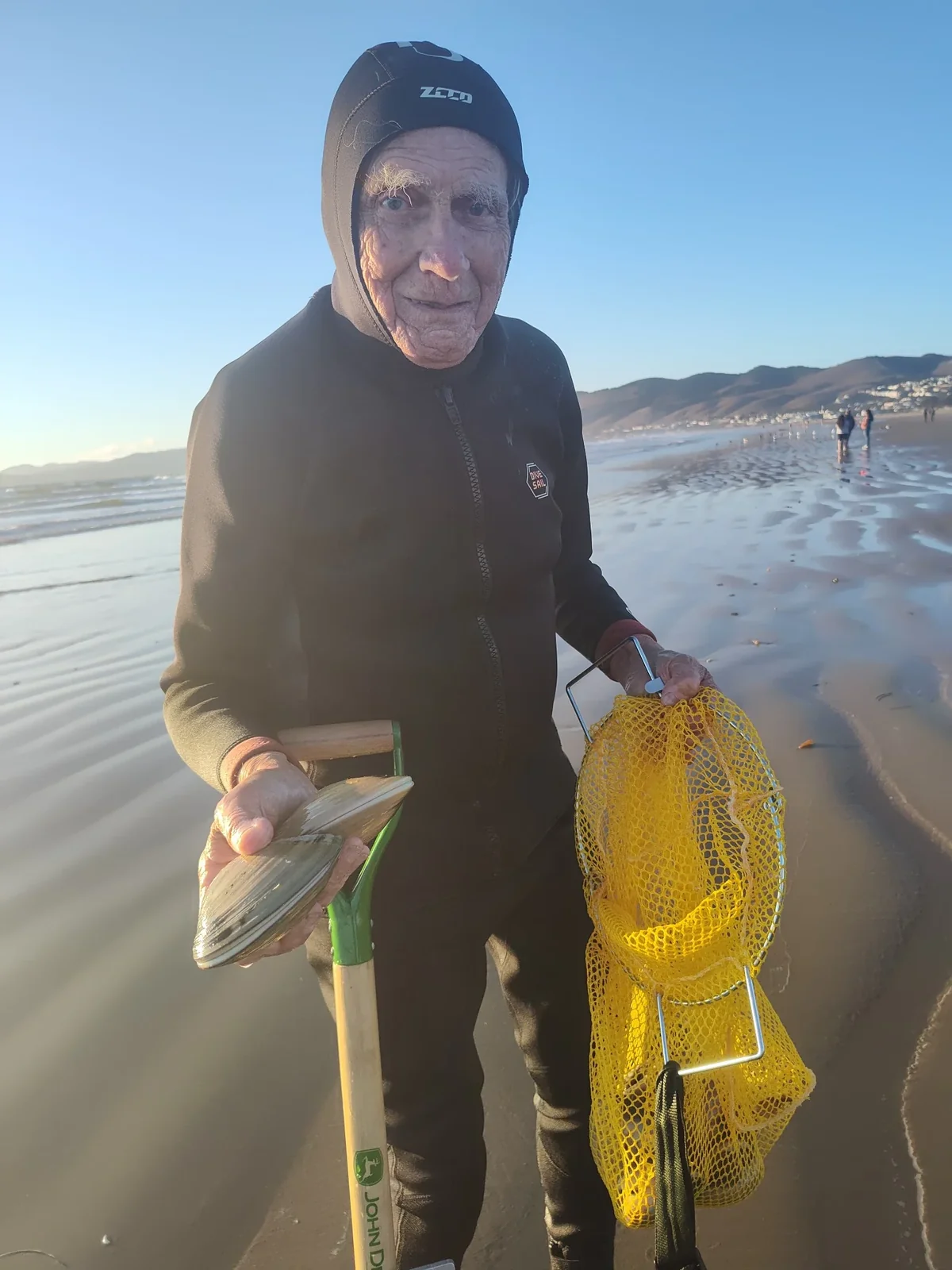
The two integrations that matter:
- Gauge mounted to the fork handle. Every clam comes up at the fork; the gauge is right there on the same tool. No fumbling for a separate measuring stick. CXB-Designs (the publisher of this resource) makes gauges of this type, as do other manufacturers; any rigid 4.5-inch gauge meeting the legal requirement will do.
- Catch bag at the waist. Hands stay free for the fork and for measuring. The bag goes where you go and stays out of the surf.
These integrations are not exotic; they are how working Pismo clammers have done it for decades. They make the difference between a session where the technique flows and a session where the gear gets in the way.
Working with Others
Pismo Beach has plenty of room. Group clamming — family, friends, a clamming day with the kids — is a long Central Coast tradition and one of the genuine pleasures of the fishery.
One legal point matters: under California regulations, each clammer must harvest only their own clams, into their own separate container. Adults cannot dig clams "for" a child or another adult and add them to a shared bag. Each licensed clammer is responsible for their own measuring, their own catch, and their own daily limit. Children below licensing age (under 16) cannot have clams harvested on their behalf and counted toward an adult's limit; they need to be doing their own clamming or not be participating in the harvest.
Beyond that, group clamming is just a matter of giving each other working room. Spread out along the productive band rather than clustering; the band runs along the beach, so a group of four can work an L-shape covering forty to sixty feet of beach without anyone bumping into anyone else. Watch the ocean for each other — a second pair of eyes calling out a sleeper wave is genuine safety value.
Beginner Mistakes
The Pismo clam fishery is so accessible that "mistakes" in the usual sense — bad spots, wrong gear, wrong technique — are rarely fatal to a session. The two genuine first-timer errors:
Giving up too early
The single most common reason a new clammer leaves Pismo Beach without a clam is having stopped probing before they reached the productive band. The procedure on this page works. If the first ten probes hit nothing, move ten feet closer to the ocean and try again. If the next ten hit nothing, move another ten feet. The band is there; finding it is a matter of minutes if you keep at it.
Losing track of the ocean
Once clams start coming up on the fork, the work becomes absorbing. The mind goes to the clam, to the gauge, to the rebury, to the next probe. The wave train, meanwhile, has not gone anywhere. The first-timer’s lesson on the Safety page is the canonical example of this mistake: a sleeper wave on a calm day, eyes on the work rather than the water, sixty feet up the beach on her back. She was unhurt. Most aren’t hurt. Some are. Stay in the sideways stance. Glance to the surf every few seconds. The sand will still be there when you look back.